Ocean shipping carries the vast majority of global trade. Around 90% of the world’s goods are transported by sea, making it the backbone of international supply chains. According to IMO statistics, the CO₂ emissions from the shipping industry account for approximately 2,7% of global greenhouse gas emissions. If left uncontrolled, this share could potentially rise to 15% by 2050, making decarbonization one of the key challenges facing the industry today.
Reducing emissions has become a central priority in ocean shipping. For Evergreen Line, this is not a new direction but an ongoing focus, reflected in investments in modern vessels, fuel flexibility and operational efficiency.
Setting long-term climate targets
To align with the global trend toward green shipping, Evergreen Marine Corp. has a CO₂ reduction target for its fleet. Using 2008 as the baseline, the company aim to reduce CO₂ emission intensity by 70% by 2030 and achieve net-zero emissions by 2050. These objectives are at the heart of Evergreen’s global climate action.
Like most shipping companies, Evergreen’s approach relies on multiple steps rather than one single technological solution.
Operational improvements remain one of the most immediate ways to reduce emissions. Measures such as speed optimization (slow steaming), improved voyage planning and more efficient cargo handling can significantly lower fuel consumption across large global fleets.
These measures have already become common practice across the container shipping sector as carriers look for ways to improve efficiency while the fuel producers continues developing scalable low-carbon fuels.
Fleet renewal as a key strategy
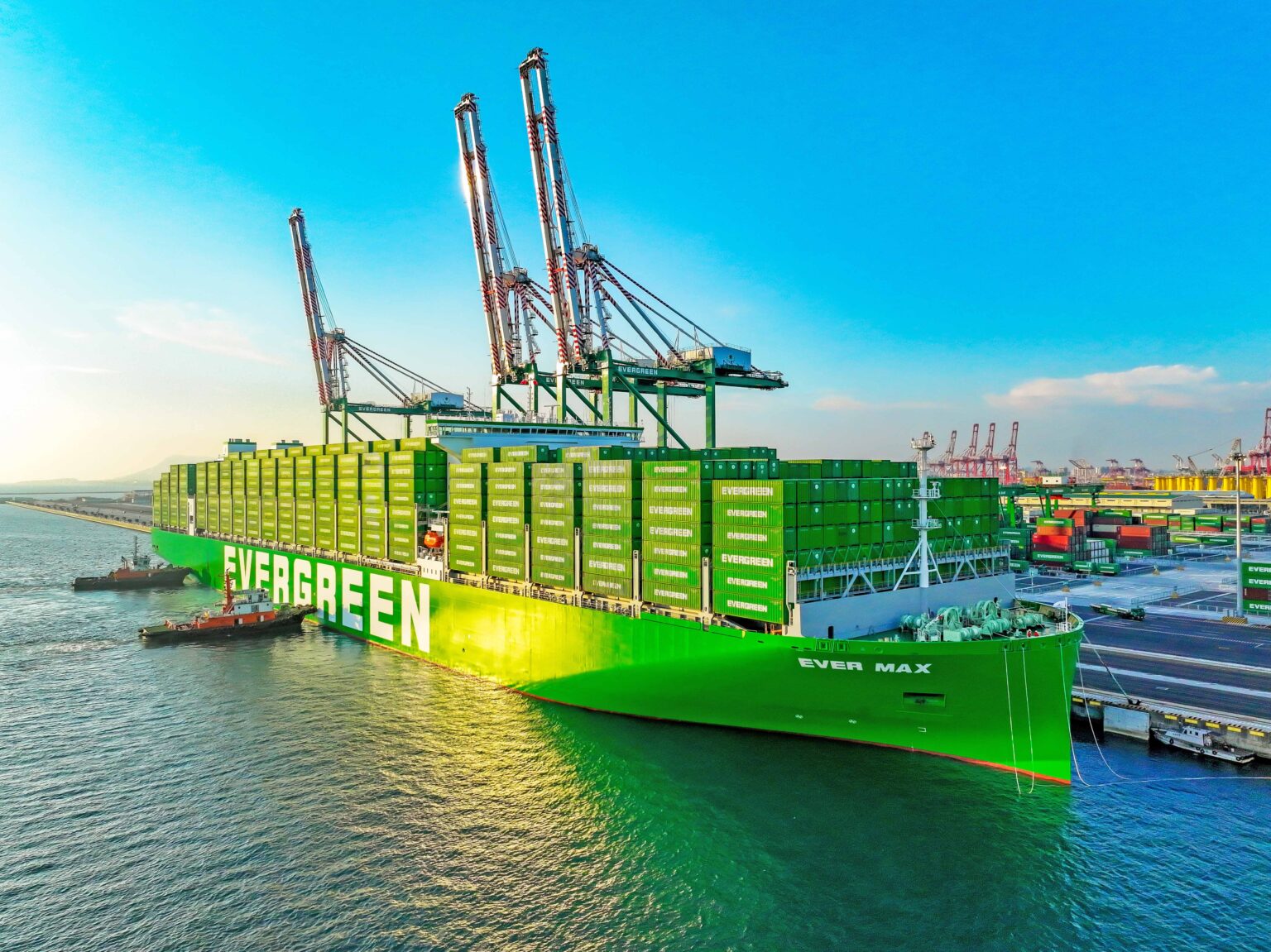
Another central part of Evergreen’s strategy is modernizing its fleet. Today, Evergreen deploys one of the most modern container vessel fleets, with around 80% of its vessels less than 10 years old – something that clearly differentiates the company within the industry.
Newer container vessels are significantly more energy efficient than previous generations thanks to improvements in hull design, propulsion systems and onboard energy management.
In recent years, Evergreen has placed several large orders for new vessels designed to support the industry’s transition toward lower-emission shipping. In 2023, the company ordered 24 methanol dual-fuel container ships of approximately 16,000 TEU capacity, designed to operate on methanol as well as conventional marine fuels.
The company has also ordered 11 ultra-large LNG dual-fuel vessels (24,000 TEU) as well as 14 LNG dual-fuel vessels of around 14,000 TEU capacity in 2025, further strengthening its dual-fuel fleet pipeline.
Together, these investments reflect a modern and forward-looking orderbook, positioning Evergreen with a fleet that is both competitive and increasingly aligned with the industry’s transition toward lower-emission shipping.
Preparing for the fuels of the future
Alternative marine fuels are widely seen as essential for reducing shipping emissions over the long term. However, the transition is complex because global infrastructure for new fuels such as methanol, ammonia or hydrogen is still developing, and volumes are still limited, with a higher cost level compared to conventional marine fuels.
By investing in dual-fuel vessels, Evergreen is preparing its fleet for a future in which different fuel solutions may coexist during the industry’s transition period.
This approach allows ships to operate using conventional fuels today while gradually shifting toward lower-emission alternatives as supply chains and port infrastructure evolve.
Efficiency improvements on board
In addition to investing in new vessels, Evergreen has introduced a range of technical and operational measures to improve environmental performance across its fleet.
These include technologies and practices such as:
- Advanced anti-fouling hull coatings that reduce drag
- Operational efficiency improvements and retrofits to reduce fuel consumption
- Ballast water management systems designed to protect marine ecosystems
- Compatibility with shore power in ports where such infrastructure is available
Together, these measures contribute to meaningful reductions in fuel consumption and emissions across the fleet.
A long-term transition for the shipping industry
Decarbonizing ocean shipping will take time. Container ships typically operate for 20–30 years, meaning that fleet renewal cycles are long and capital-intensive. At the same time, the global infrastructure needed for alternative fuels is still being developed.
For carriers like Evergreen, the transition therefore involves balancing short-term efficiency improvements with long-term investments in new vessels and fuel technologies.
The International Maritime Organization (IMO) has, through its 2023 revised greenhouse gas strategy, set a target of reaching net-zero emissions from international shipping by around 2050. While discussions on how to implement this – including elements of a global regulatory framework – are ongoing, the investments being made today by container carriers will play an important role in shaping whether the industry can reach that ambition.
As shipping continues to evolve, strategies like Evergreen’s — combining operational efficiency, modern vessels and fuel flexibility — are likely to remain central to the industry’s pathway toward lower-emission ocean transport.